
Wondering if it’s a sprain or a broken arm? The clearest clue is what happens when you try to move it. A sprain usually still allows some movement, even if it hurts. A break often makes movement nearly impossible, and the pain tends to be sharp and localized right over the bone.
Swelling, bruising, and pain show up with both injuries, which is exactly why so many people can’t tell the difference right after it happens.
What a Sprain Actually Is
A sprain is an injury to a ligament, the tough band of tissue that connects bone to bone at a joint. In the arm, this usually happens at the wrist or elbow.
When a joint gets twisted, bent, or forced beyond its normal range, the ligament stretches or tears. That’s what causes the pain and swelling.
What a Broken Arm Actually Is
A broken arm means an actual crack or fracture in one of the arm bones, whether that’s the humerus, radius, or ulna.
Breaks can be tiny hairline fractures that are easy to miss, or complete breaks that cause obvious deformity. Both types can happen from the same kinds of falls or impacts that cause a sprain.
Signs That Point to a Break
Certain patterns show up consistently in people who turn out to have a fracture rather than a sprain.
A visible bend, bump, or deformity. If the arm looks crooked or has a bump that wasn’t there before, that’s a strong sign of a break.
A cracking or snapping sound at the moment of injury. Many people recall hearing or feeling this right as it happened.
Pain directly over the bone, not just around the joint. Sprains tend to hurt around the joint itself. Fractures often hurt at a specific point along the bone.
Inability to rotate or use the arm at all. Struggling to turn your wrist, straighten your elbow, or bear any weight leans toward fracture.
Swelling that appears fast and looks severe. Both injuries swell, but fracture swelling tends to come on quickly and look more dramatic.
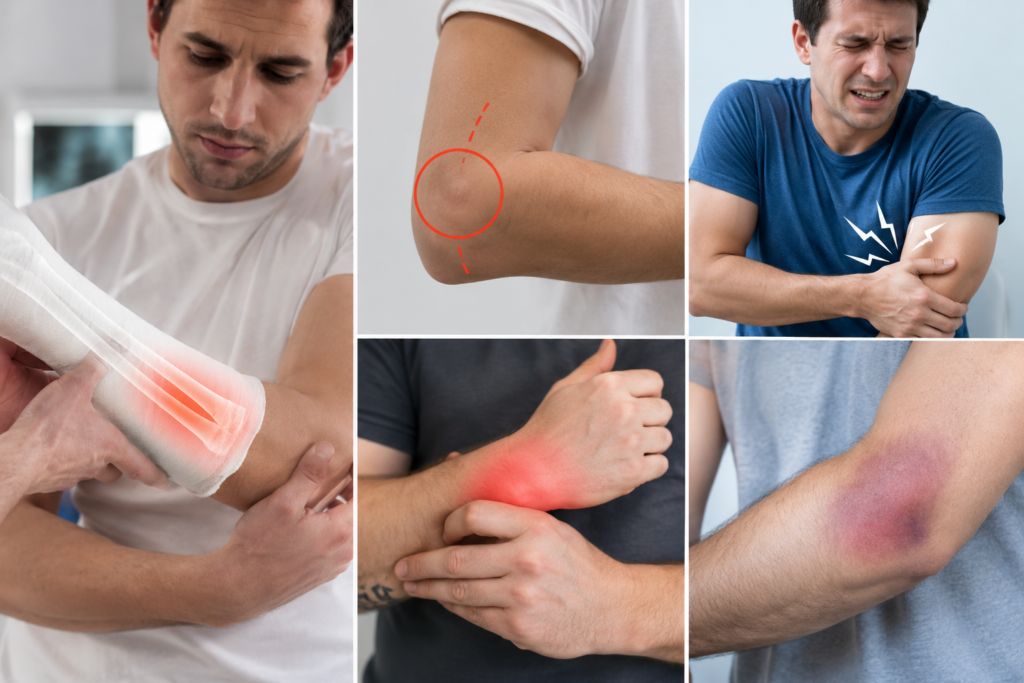
Signs That Point to a Sprain
With a sprain, you can usually still move the joint, even though it’s uncomfortable and stiff.
Pain is often more diffuse around the joint rather than pinpointed on the bone. Bruising develops gradually and tends to spread from the injury site outward.
Most sprains also feel noticeably better within a few days, especially with rest and ice.
What People Usually Get Wrong
The most common mistake is assuming that if you can still move your arm, it can’t be broken. That’s not always true. Some fractures, especially hairline cracks or breaks near a joint, still allow limited movement.
Another mistake is judging severity by swelling alone. A bad sprain can swell just as much as a minor fracture, sometimes more.
Pain intensity isn’t reliable either. Some fractures feel duller than expected once initial shock wears off, while a severe sprain can be intensely painful for days.
When It Becomes Serious
A few warning signs mean you shouldn’t wait it out at home.
Seek care right away if you notice any of the following.
- The arm looks visibly bent, shortened, or out of place
- You cannot move or use the arm at all
- Numbness, tingling, or a cold sensation in the hand or fingers
- Skin is broken near the injury, especially if the bone is visible
- Pain keeps intensifying instead of easing with rest
- The area around the injury turns pale or unusually cold
These can point to a fracture that needs prompt treatment to prevent nerve damage or poor healing.
How This Is Actually Diagnosed
Here’s the part that matters most. You can’t reliably tell a sprain from a break just by looking at it or pressing on it. Imaging is the only way to know for sure.
An X-ray will show most fractures clearly, including hairline cracks that aren’t visible from the outside. If the X-ray comes back clean but pain and swelling continue, a sprain is the likely explanation.
A CT scan gives a more detailed look and is especially useful for complex fractures near a joint, or when an X-ray isn’t conclusive enough on its own.
This is where fast access to imaging really matters. At Priority Emergency Center in Austin, board-certified emergency physicians are on site 24 hours a day, with CT scan and lab testing available immediately, so you get a clear answer instead of a guess.
What to Do Right After the Injury
While you’re deciding whether to get it checked, a few steps help regardless of which one it turns out to be.
Rest the arm and avoid using it for lifting or gripping. Apply ice for 15 to 20 minutes at a time to reduce swelling. Keep the arm elevated above heart level when possible. Avoid forcing movement to test how bad it is.
What you shouldn’t do is wait several days hoping it improves on its own, especially if the pain isn’t easing or the arm looks different than usual. An untreated fracture can heal poorly, sometimes requiring more involved treatment down the line.
When to Just Get It Checked
If there’s genuine doubt, get it evaluated. Treating a break like a sprain carries far more risk than getting checked and finding out it’s a sprain after all.
Priority Emergency Center is open 24 hours a day at 3563 Far West Blvd, Austin, with zero wait time and same-visit access to X-ray, CT scan, and lab work, so you get answers the same day, not days later.
Quick Answers
Does a sprain hurt more than a broken arm?
Not necessarily. Pain levels vary by person and injury, which is why pain alone isn’t a reliable way to tell them apart.
Can you move your arm if it’s broken?
Sometimes, especially with hairline fractures. Being able to move it does not rule out a break.
How long does a sprained arm take to heal?
Most mild to moderate sprains improve within one to three weeks with rest and proper care.
Can an X-ray miss a broken arm?
Occasionally, especially with very small hairline fractures. If pain continues after a clear X-ray, further imaging or follow up may be needed.


