
Can urgent care drain a cyst? This is one of the most common questions people ask when they notice a painful, swollen lump under their skin and want answers fast. Whether it appeared overnight or has been growing for weeks, a cyst that starts to hurt, fill with pus, or show signs of infection is something most people want dealt with the same day. The good news is that in many cases, urgent care is a completely appropriate and accessible option. That said, not every cyst is the same, and knowing what urgent care can and cannot handle will help you make the right call.
Can Urgent Care Drain a Cyst Safely?
Yes, in most straightforward cases, urgent care can drain a cyst safely and effectively. Urgent care centers are staffed by licensed medical providers, including physicians, physician assistants, and nurse practitioners, who are trained to perform minor surgical procedures like incision and drainage. If you have a surface-level infected cyst, an abscess, or an inflamed lump that has not complicated beyond what the clinic can handle, walking into an urgent care center is a practical choice that can save you both time and the high cost of an emergency room visit.
Urgent care works well for uncomplicated cysts that are accessible on the skin, showing clear signs of infection or pressure, and small enough to treat without imaging or IV medications. For those situations, urgent care cyst drainage is a reliable, same-day solution with no appointment needed at most clinics.
What Types of Cysts Can Urgent Care Treat?
Common Cysts Treated at Urgent Care
Most walk-in cyst treatments handled at urgent care fall into a recognizable category. These are typically close to the surface of the skin, clearly infected or inflamed, and cause enough discomfort that the patient wants them drained without delay.
Sebaceous cyst
These form in the skin’s oil glands and are among the most frequently drained cysts at urgent care. When a sebaceous cyst becomes infected and fills with pus, it becomes an ideal candidate for urgent care cyst treatment.
Epidermoid cyst
Technically different from sebaceous cysts but often grouped in casual conversation, epidermoid cysts are benign keratin-filled lumps that can become tender and swollen. Infected versions respond well to urgent care incision and drainage.
Infected cyst
Any cyst, regardless of type, that has become warm, red, and painful due to bacterial infection can typically be addressed at urgent care through a standard cyst drainage procedure.
Inflamed cyst
Not every inflamed cyst is infected, but inflammation alone can cause significant pain and pressure. Urgent care providers can evaluate and treat these on-site.
Abscess or boil
An abscess is essentially a pocket of pus caused by infection, and a boil is a type of skin abscess. Both are classic cases for urgent care abscess treatment and are among the most commonly handled skin issues at walk-in clinics.
Cysts That May Need a Specialist
Some cysts fall outside what urgent care is designed to handle. Recognizing these situations early can prevent delays in proper treatment.
Deep cyst
A cyst located deep beneath the skin surface, especially near nerves, tendons, or organs, requires imaging and possibly a surgical setting. Urgent care is not equipped for deep cyst removal.
Large or recurrent cyst
If a cyst has come back multiple times after previous drainage, or if it is unusually large, a dermatologist referral or surgical removal may be the only lasting solution. Urgent care can manage the immediate infection, but the underlying cyst wall often needs full excision to prevent recurrence.
Ganglion cyst
These fluid-filled lumps typically appear near joints or tendons, most commonly on the wrist. They are usually handled by orthopedic specialists or hand surgeons rather than urgent care providers.
Pilonidal cyst in severe cases
Located at the base of the spine, a pilonidal cyst that has developed into a large or complicated abscess often needs specialist management, especially if it is recurrent or deeply infected.
Signs a Cyst May Need Drainage
Not every cyst needs to be drained immediately, but certain signs indicate that waiting is not a great idea. Here is what to watch for:
Painful or tender lump
A cyst that was once painless but has become sore to the touch is often beginning to show signs of infection or internal pressure buildup. This is usually when same-day cyst treatment becomes necessary.
Redness and swelling
Visible redness spreading around the cyst, along with noticeable swelling, suggests the area is inflamed or infected. This is a common trigger for patients to seek urgent care for cyst drainage.
Pus-filled cyst
If you can see or feel that the lump is soft, fluctuant, or appears to contain fluid, it is likely a pus-filled cyst that needs to be drained to relieve pressure and clear the infection.
Warmth around the area
Warmth around a cyst, especially combined with redness, is a reliable indicator of active infection and a reason to get it looked at the same day.
Rapid growth
A cyst that doubles in size over a few days is concerning. Rapid growth often signals accelerating infection or abscess formation.
Fever or signs of infection
A fever from infection accompanying a skin lump is a red flag. It suggests the infection may be spreading beyond the immediate area, which requires prompt evaluation.
Cellulitis symptoms
Spreading redness, warmth, and swelling beyond the cyst borders may indicate cellulitis, a deeper bacterial skin infection. This situation may warrant an emergency evaluation depending on severity. You can learn more about when symptoms become an emergency by visiting Priority Emergency Center.
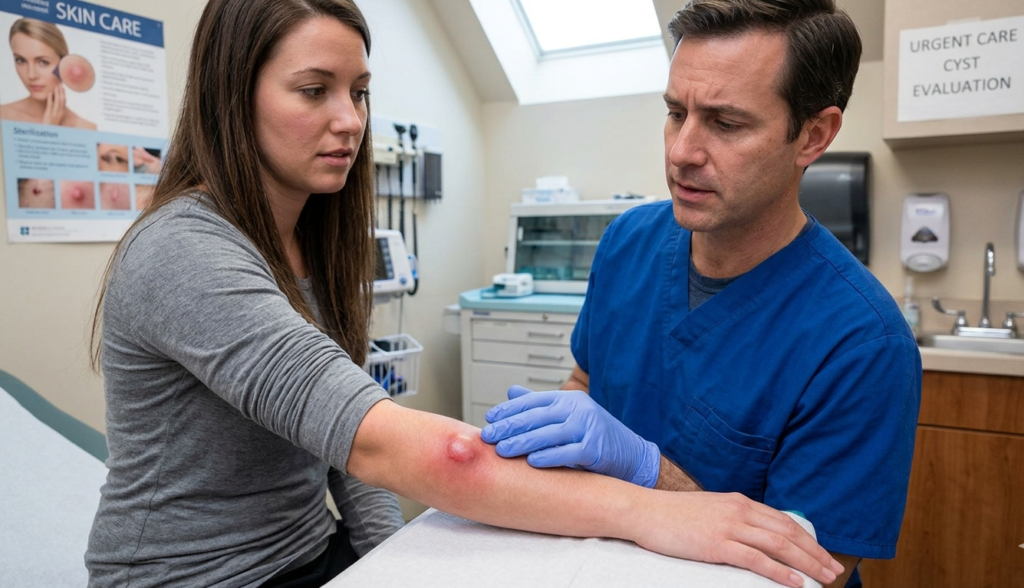
How Urgent Care Drains a Cyst
Step-by-Step Procedure
The urgent care incision and drainage procedure is a minor surgical procedure, typically completed in under 30 minutes for most uncomplicated cysts. Here is what usually happens:
Exam and evaluation
The provider examines the cyst, checks for signs of deep infection, and confirms that the lump is appropriate for in-office drainage. They may ask about how long it has been there, whether it has grown, and if you have had it before.
Local anesthesia or numbing medication
Before any incision, the area is numbed using a local anesthetic injection. Most patients describe a brief sting from the numbing medication itself, after which the area becomes completely numb.
Small incision
The provider makes a small incision directly over the cyst using a scalpel. The size depends on the cyst’s dimensions and how much drainage is needed.
Draining pus or fluid
Once the incision is made, the contents of the cyst, whether pus, keratin, or other fluid, are expressed and removed. This is the core of the cyst drainage procedure.
Cleaning the cyst wall
The inside of the cavity is cleaned to reduce the risk of immediate reinfection. This step is important because leaving infected material behind can lead to recurrence.
Packing the wound if needed
For larger abscesses or deeper cavities, the provider may pack the wound with sterile gauze. This keeps the wound from closing too quickly before the inside heals, which reduces the chance of a new abscess forming underneath.
Is the Procedure Painful?
Most patients are pleasantly surprised by how manageable the procedure is. The only genuinely uncomfortable moment for most people is the injection of local anesthesia, which causes a brief burning or stinging sensation. Once the numbing medication takes effect, the incision and drainage itself are generally not painful. You may feel pressure or movement, but sharp pain should not be present.
Recovery time varies, but most people feel noticeably better within 24 to 48 hours after drainage because the pressure and infection are relieved almost immediately. The wound itself typically takes one to two weeks to close, depending on its size.
Aftercare and Healing Process
Proper wound care after urgent care cyst drainage is essential for full recovery and for preventing reinfection. Here is what most providers will recommend:
Keeping the area clean: Gently washing the wound with mild soap and water once or twice a day helps prevent bacteria from entering the healing tissue.
Dressing changes: If the wound was packed, you will likely need to return for repacking or learn how to change the dressing yourself at home. The provider will give you specific wound care instructions based on your individual case.
When antibiotics are prescribed, not every drained cyst requires antibiotics, but if the surrounding tissue shows signs of spreading infection, oral antibiotics are typically prescribed. It is important to complete the full course even if the area improves quickly.
Signs of infection to watch for: After drainage, watch for worsening redness, increased swelling, discharge with a strong odor, or a return of fever. These signs suggest the infection may not have cleared completely, and a follow-up visit is warranted.
When Urgent Care Is Not Enough
As capable as urgent care centers are for straightforward cases, there are situations where urgent care limitations become relevant, and a higher level of care is needed.
Deep or complicated cysts – When a cyst is located near sensitive anatomical structures or has extended deeper than the skin layer, urgent care providers may not be able to safely complete drainage without imaging guidance.
Recurrent cysts – If you have had the same cyst drained multiple times and it keeps returning, the problem is the cyst wall itself, not just the contents. Surgical removal of the entire cyst, including the sac, is the only definitive solution. This typically requires a dermatologist referral or a visit to a general surgeon.
Need for imaging or ultrasound – Some cysts require ultrasound imaging to determine their depth, proximity to blood vessels, or internal structure before drainage. Most urgent care clinics do not have this capability on site.
IV antibiotics – When an infection has spread significantly or a patient has signs of systemic illness, IV antibiotics administered in a monitored setting may be necessary. Urgent care centers are not set up for this level of treatment.
Referral to dermatologist or surgeon – Complicated cyst cases, unusual growths, or anything that looks atypical will typically result in a referral to a specialist for further workup and treatment.
If your situation has gone beyond what a walk-in clinic can handle, Priority Emergency Center’s 24/7 emergency and trauma care is available around the clock for cases that require a higher level of evaluation and treatment.
Urgent Care vs Emergency Room for Cyst Drainage
Understanding the difference between urgent care and the emergency room can save you time, money, and unnecessary stress.
When urgent care is the right choice, For most infected skin cysts, abscesses, and boils that are painful but not life-threatening, urgent care cyst treatment is the smarter first stop. It is faster, less expensive, and specifically designed for this type of walk-in care. No appointment is needed at most locations, and same-day cyst treatment is a realistic expectation.
When to go to the ER – If you have a rapidly spreading infection, high fever, severe pain, signs of sepsis, or a cyst in a sensitive location like the face or groin that is deteriorating quickly, the emergency room is the appropriate choice. Emergency rooms have surgical staff, imaging equipment, and IV medications available at all times. For pediatric cases involving infected skin lumps in children, Priority Emergency Center’s children’s ER services provide specialized pediatric emergency care with immediate availability.
Cost and wait time comparison – Emergency rooms are significantly more expensive than urgent care centers, and wait times are often longer for non-life-threatening conditions. If urgent care can handle your situation, it is almost always the more practical choice.
Same-day treatment benefits – One of the clearest advantages of urgent care for cyst drainage is the ability to walk in and receive treatment the same day without scheduling weeks in advance. For an infected or rapidly growing cyst, this accessibility matters.
Frequently Asked Questions
Can I Walk In for Cyst Drainage?
Yes. Most urgent care centers accept walk-in patients for cyst drainage without requiring a prior appointment. If you have a painful cyst, an inflamed abscess, or an infected lump, you can typically walk in and be evaluated the same day.
Do I Need an Appointment?
In most cases, no. Walk-in cyst treatment is one of the primary benefits of choosing urgent care over a dermatologist or surgeon, both of whom may have wait times stretching days or weeks.
How Long Does Cyst Drainage Take?
The procedure itself usually takes between 15 and 30 minutes from start to finish for a straightforward case. Total visit time, including check-in, evaluation, and aftercare instructions, may run 45 minutes to an hour.
Will the Cyst Come Back?
Drainage removes the contents of the cyst but does not always remove the cyst wall. If the sac remains intact beneath the skin, there is a chance the cyst can refill over time. Complete surgical excision by a dermatologist or surgeon is the most reliable way to prevent recurrence.
Is Cyst Drainage Covered by Insurance?
In most cases, yes. Cyst drainage at urgent care is generally considered a medically necessary procedure and is covered by most health insurance plans, subject to your deductible and copay. It is always a good idea to confirm coverage with your provider before your visit.


